# Download Settings (/docs/download-settings)
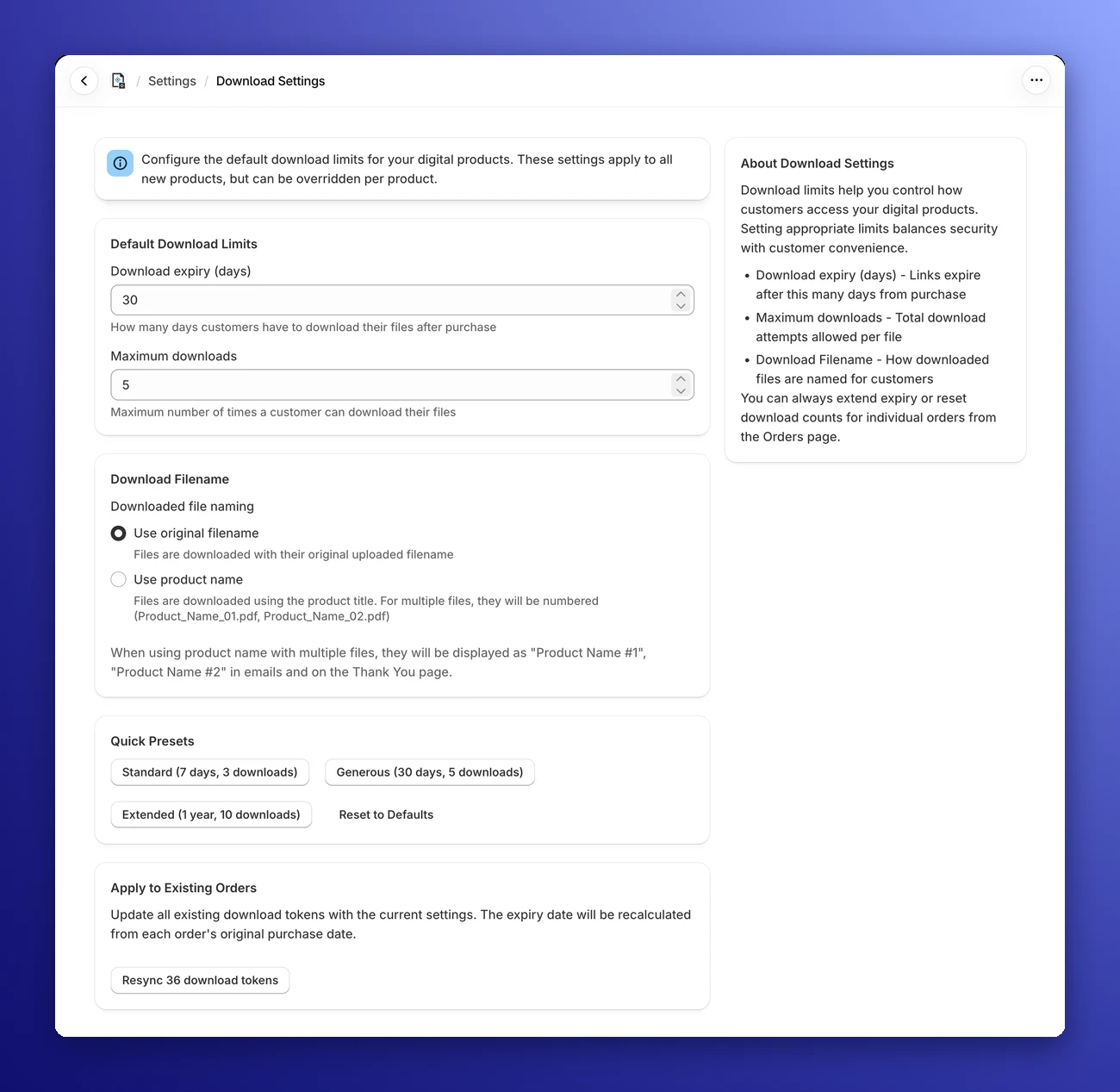
The **Download Settings** page allows you to define the default download limits for your digital products. Think of these as your store's baseline security rules.
**Note:** These defaults apply to every product that doesn't have its own download limits (you can set those on the [product page](/docs/product)). A change applies to download links created after you save. Links your customers already have keep their old limits, unless you use **Apply to Existing Orders** below.
---
## Default Download Limits [#default-download-limits]
Balancing security with customer convenience is key. These settings control how long a customer has access to their files.
- **Download expiry (days):** Set the number of days a download link remains active after purchase, from **1 to 365**. After this period, the link will expire. New stores start at **7 days**.
- **Maximum downloads:** Set how many times a customer can download each file, from **1 to 100**. This prevents a single purchase from being shared with a large group. New stores start at **3 downloads**.
**Pro Tip:** You can always extend the expiry date or reset the download count for a specific customer from that order's page on the **Orders** page if they run into issues.
---
## Download Filename [#download-filename]
This section controls how the files are named when your customers save them to their computer.
- **Use original filename:** The file will keep the exact name it had when you uploaded it (e.g., `my-snowboard-guide-v3.pdf`).
- **Use product name:** The file will be renamed to match the product title in your store. This is often cleaner and more professional for the customer.
- *For multiple files:* If a product has more than one file, they will be sequentially numbered (e.g., `Snowboard_Guide_01.pdf`, `Snowboard_Guide_02.pdf`). In emails and on the Thank You page, they are listed as "Snowboard Guide #1", "Snowboard Guide #2".
- *Special characters:* Spaces and special characters become underscores, and so do accented and non-Latin letters. If none of the title is left, the original filename is used. If your product titles aren't in plain English letters, **Use original filename** may give nicer names.
---
## Quick Presets [#quick-presets]
Not sure what to choose? We have defined three common configurations you can apply with a single click:
- **Standard:** 7 days expiry, 3 downloads.
- **Generous:** 30 days expiry, 5 downloads (This is a good starting point).
- **Extended:** 1 year expiry, 10 downloads.
Next to the presets, **Reset to Defaults** fills in 7 days, 5 downloads and **Use original filename**. Presets and the reset only fill in the form, so click **Save** afterwards to keep the change.
---
## Apply to Existing Orders [#apply-to-existing-orders]
By default, changing the settings above only affects *future* orders. However, sometimes you might want to change the rules for everyone, for example, if you decide to increase the download limit from 3 to 5 for all past customers.
You can do this using the **Apply to Existing Orders** section at the bottom of the page. The button shows how many download links will be updated (e.g., **Resync 120 download tokens**), and opens a confirmation listing the new expiry and download limit. Click **Resync All** to start.
* **How it works:** This updates every download link your customers already have to your **saved** settings, so save any changes first. The expiry date is recalculated based on the order's **original purchase date**.
* **What stays the same:** Download counts aren't reset. If a customer used 3 downloads and you raise the limit to 5, they have 2 left. Products with their own download limits use those instead of the store defaults. Links revoked because of a refund are skipped.
* **In the background:** The update runs in the background and a message tells you when it's done.
* *Example:* If you set expiry to **30 days** and a customer bought the item **40 days ago**, resyncing will cause their link to expire immediately.